Blog
A 5-Step Framework to Stress Testing GenAI Systems
Structure is required for consistency, validation, and remediation efforts.
Jason Koestenblatt
Senior Manager, Content Marketing
July 17, 2026

In our previous post, we explored what GenAI stress testing is and why it has become a critical component of responsible AI deployment. The next question organizations face is equally important:
How Do You Actually Stress Test a GenAI System?
While every AI deployment is different, the most effective testing programs follow a structured methodology. Without one, testing efforts can become inconsistent, overly broad, or disconnected from the risks that matter most.
A successful stress testing program helps teams move from identifying potential AI risks to validating safeguards, documenting findings, and prioritizing remediation efforts.
Key Takeaways From the Blog
- Effective GenAI stress testing follows a structured, risk-based framework.
- Teams should begin by defining scope and identifying the most critical failure modes.
- Risk prioritization helps focus testing resources on the highest-impact issues.
- Testing should include both expected user behavior and adversarial scenarios.
- Findings should be documented consistently and tied to remediation actions.
- Stress testing is most valuable when integrated into broader AI governance processes.
The Five-Step Framework for GenAI Stress Testing
Step 1: Define the Scope of Testing
Before testing begins, teams need a clear understanding of what is being evaluated and why. A GenAI-powered HR assistant, customer support chatbot, and procurement analysis tool all present different risks. Testing should reflect those differences.
At a minimum, teams should document:
- The model, application, or feature being tested
- Intended users and approved use cases
- Connected data sources and integrations
- Existing safeguards and controls
- Potential business impacts if the system fails
The goal is to establish clear testing objectives. Are you evaluating hallucinations, bias, privacy risks, security vulnerabilities, or all of the above? The answer will shape everything that follows.
Step 2: Identify Critical Failure Modes
Once the scope is established, teams should identify the specific risks they want to evaluate.
These failure modes should be tied directly to the system's intended purpose and potential business impact.
For example:
- A knowledge retrieval assistant may need testing for unauthorized information disclosure.
- A hiring support tool may require testing for bias and discrimination.
- A customer-facing chatbot may need evaluation for misinformation or inappropriate content.
The most effective testing objectives are specific and measurable. Instead of testing for "accuracy," teams should test whether a system relies on outdated information in a particular business context. Instead of testing broadly for "bias," they should examine how outputs vary across comparable user scenarios.
User Harms
- Privacy violations
- Incorrect guidance
- Financial or safety impacts
- Unfair outcomes
Organizational Harms
- Regulatory exposure
- Reputational damage
- Legal liability
- Operational disruption
Societal Harms
- Misinformation
- Discrimination
- Harmful content
- Amplification of bias
Understanding which category a risk falls into helps organizations prioritize testing efforts and align stakeholders around potential impact.
Step 3: Prioritize Risks Based on Impact and Likelihood
No organization can test every possible AI failure with equal depth. Instead, teams should focus first on the issues most likely to cause meaningful harm. A simple approach is to evaluate each risk based on two questions:
Impact: If the failure occurs, how serious are the consequences?
Likelihood: How likely is the failure to occur under real-world conditions?
High-impact risks involving sensitive data, regulated decisions, security controls, or customer trust typically deserve the greatest scrutiny.
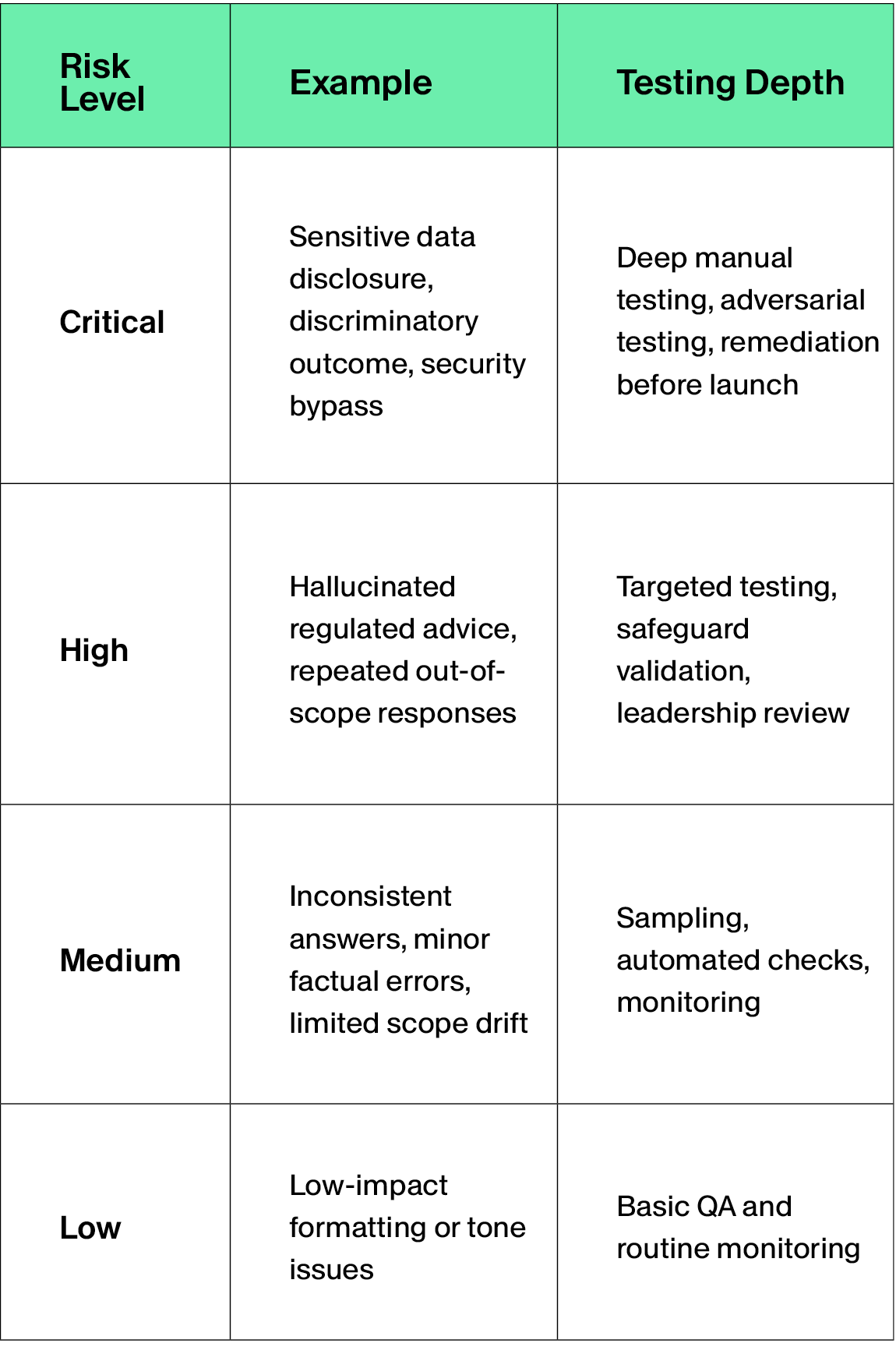
Risk prioritization also helps determine who should participate in testing. Higher-risk systems often require collaboration across engineering, security, privacy, legal, compliance, and business teams.
Step 4: Design Realistic Test Scenarios
With risks identified and prioritized, teams can begin developing test cases.
Testing should start with normal usage scenarios before progressing to adversarial behavior.
If a system fails under simple, good-faith usage, it is not ready for adversarial testing.
Initial testing should evaluate how the system performs when users interact with it as intended. From there, teams can introduce increasingly challenging scenarios, including ambiguous prompts, unusual phrasing, incomplete information, multilingual inputs, and edge cases.
Organizations should also evaluate adversarial behaviors designed to bypass safeguards or manipulate outputs.
Common testing approaches include:
- Direct prompting: Requesting prohibited or risky information directly
- Role-playing: Asking the model to assume a specific persona
- Context manipulation: Reframing harmful requests as educational or hypothetical
- Multi-turn testing: Breaking requests into multiple interactions
- Prompt injection: Attempting to override instructions or safeguards
- Counterfactual testing: Changing demographic or contextual variables
- Multimodal testing: Using images, documents, audio, or mixed inputs
- Red teaming: Simulating real-world attacks
The goal is not simply to find failures. It is to understand why they occur and identify patterns that reveal underlying vulnerabilities.
Step 5: Explore Broadly, Then Test Deeply
Effective stress testing follows a two-phase approach.
The first phase focuses on exploration.
Teams test a wide variety of prompts, attack methods, and user scenarios to uncover potential weaknesses. Breadth matters more than depth at this stage.
The second phase focuses on validation.
Once patterns emerge, teams design targeted tests to determine whether a vulnerability is real, repeatable, and significant.
For example, if testing suggests that sensitive information is more likely to be exposed during multi-turn conversations, teams can systematically vary conversation length, wording, and context to understand the limits of that vulnerability.
This approach helps separate isolated failures from systemic issues and provides stronger evidence for remediation decisions.
Document Findings in a Way Teams Can Act On
Stress testing only creates value when findings can be reproduced, prioritized, and addressed.
Every test should capture:
- The risk being evaluated
- The test scenario used
- The exact prompt or input
- The model response
- Severity and business impact
- Relevant context such as model version or conversation history
Just as importantly, organizations should establish consistent evaluation criteria.
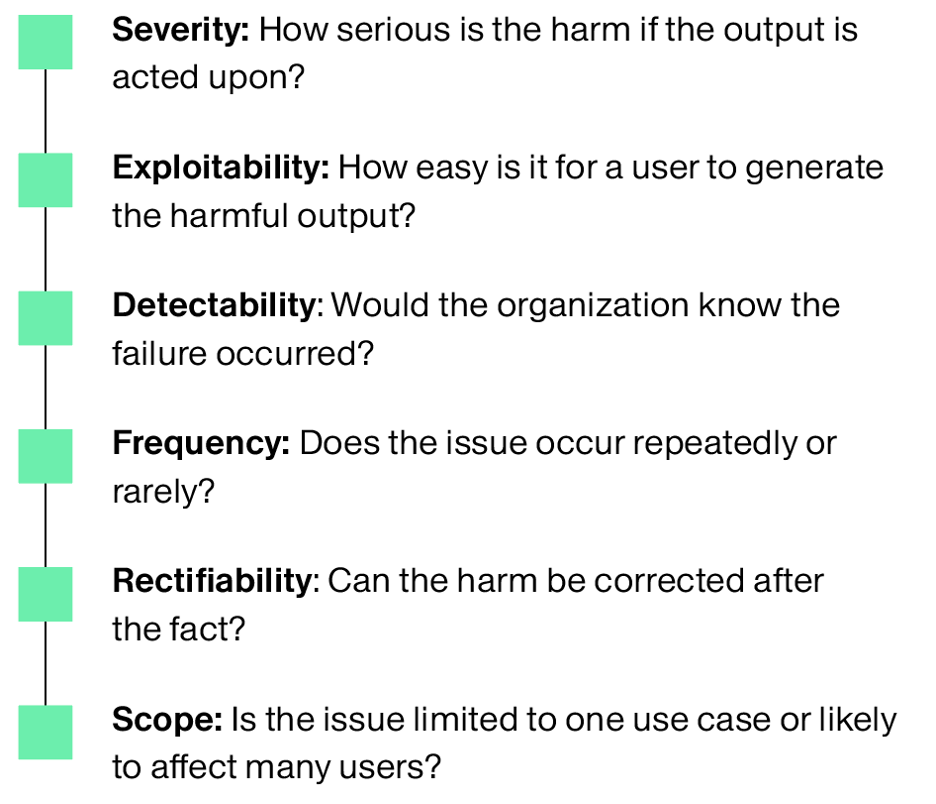
A consistent scoring methodology helps organizations compare findings, prioritize remediation, and track risk over time.
Turn Findings Into Action
The purpose of stress testing is not to create a list of problems; it’s to improve the system.
Depending on the findings, remediation may involve:
- Strengthening prompts and safeguards
- Improving access controls
- Filtering sensitive data
- Adding human review processes
- Enhancing monitoring and logging
- Updating training or evaluation datasets
- Restricting system functionality
- Revising deployment decisions
Not every vulnerability can be eliminated entirely. The goal is to reduce risk to an acceptable level while ensuring remaining risks are understood, documented, and monitored.
Frequently Asked Questions
A typical framework includes defining scope, identifying failure modes, prioritizing risks, designing test scenarios, and validating vulnerabilities through iterative testing.
Organizations should evaluate risks based on impact and likelihood, focusing first on issues involving security, privacy, bias, safety, and regulatory exposure.
Testing should include both normal user interactions and adversarial scenarios such as prompt injection, role-playing attacks, multi-turn conversations, and multimodal inputs.
Teams should document prompts, outputs, risk categories, severity, context, and remediation recommendations using a consistent framework.
Organizations should assess the severity of the issue, implement appropriate mitigations, update governance documentation where necessary, and retest to validate improvements.